Wednesday, January 24, 2024

How to clear cache in a browser

 1. Click on three dots at the top left, then click on Settings


2. Search for "clear," then click "Clear browsing data."


3. Choose which data to clear, then click "Clear data."


Sunday, April 23, 2023

Who wrote it, human or AI?

I asked AI Content Detector to check if the content was generated by a human or by AI. The Detector failed. Here is what I did.

First, I asked GPT4, "What would it take to avoid detection as being an AI generated content?" It gave me a list of items. I asked my question here.


Then I asked it to generate some content using its own advice.
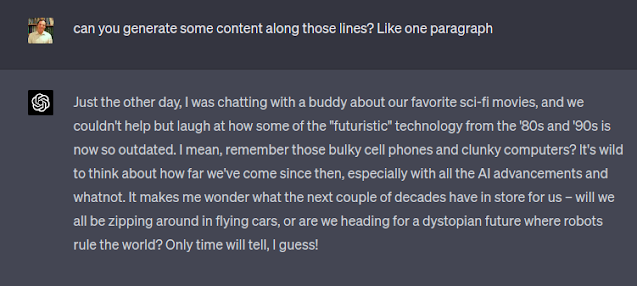


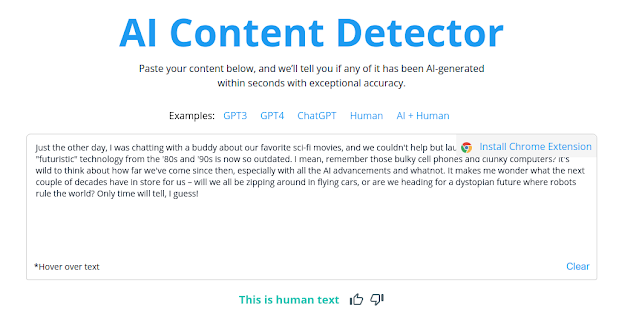
Now, I copied and pasted this text into the AI Content Detector. 


At that, AI passed with flying colors, and the AI Content Detection confidently declares, "This is human text."


What are the teachers to do? I mean, how do they distinguish whether the student wrote his work or the AI did. As a joke, I can suggest the AI would do it better. But then it can imitate a bad student as well.

A better advise comes from the CEO of OpenAI, creator of ChatGPT. According to Sam Altman, the teaching process will have to change. The teacher will spend more time interacting with the students and teaching them. A practical advice: ask the student in class to outline their ideas, and they can expand on them at home. Keep in mind that the expansion may come from ChatGPT.

Thursday, April 13, 2023

My favorite books on quantum physics

 Because of my interest in quantum computing, here are my favorite books on quantum physics. Of course, I am very much indebted to Olivia Lanes, but I also added some of my own.


Quantum Entanglement by Jed Brody.

The most modern of the list, a PDF is easily found on the web, and the book is free on Audible! It is published in the MIT press essential knowledge series, which is always very good.


Fun read. Superheroes take on quantum physics.


With characters are Enshteinish and Schrodinger Cat.


Quantum Physics - what everyone needs to know.

Serious and very clear. In 2015, has a chapter on quantum computing and what such quantum computers would do if they ever exist. Now they do!!


A popular explanation from Cambridge - technical enough. But if you are interested in quantum computing, light reading does not suffice.


Finally, a textbook for students, with formulas and exercises.


The best (others are also good)

https://www.amazon.com/Quantum-Computation-Information-10th-Anniversary/dp/1107002176


How to talk about quantum computing to your teenager

https://www.quora.com/What-is-an-intuitive-explanation-of-quantum-computing

Thursday, January 12, 2023

Pointers for Google Certification Exam

I am a Google trainer, and I failed the re-certification exam after four years of teaching. Now I am done with this embarrassing confession. I asked my colleagues, also trainers. Here I am collecting their advice, with my comments.

  1. The exam got harder. Be humble and prepare for the exam.
  2. Study Google documentation, in particular, the description of the companies on which the questions are based.
  3. Cloud Guru course. It is two years old and has a 2-hours practice test at the end. Add your own knowledge and experience that you can get from QwikLabs.
  4. Question dump - you can find them on the web. They may be outdated and (very importantly) give you the wrong answers. At least the Apigee test dump was that way.
  5. Good luck!
  6. I passed, so it must have worked.

Friday, August 26, 2022

Demo for FreeEed

 Recently, I taught a class about Search and Elastic. As part of this class, I gave the students a lab showcasing FreeEed as an example of a real-world application. Here is the lab which you might find helpful as well

https://github.com/elephantscale/elastic-labs/blob/master/integrations/1-FreeEed.md

Enjoy!

Tuesday, June 28, 2022

I am excited by GitHub Copilot

 Advertised as "Your AI Pair Programmer," GitHub Copilot indeed works very well, and I am impressed. The promise is that "you write the comments, and it writes the implementation code." I did not read this documentation but just started writing code. It worked like magic.

I got a value from a hash table. It offered to check that the value existed and was not empty. The suggestion is shown in the pale font.


I then hit the tab to accept. The suggestion was bolded.


I saved a few seconds. I also saved some brain CPU cycles. I had a comfortable feeling that the code was in good style. I wasted half an hour sharing my excitement with the world.

There is more! It writes my comments. And often, it gets is right. If not, then often enough, I can still accept and change a word or two.

Thumbs up, GitHub.

Thursday, March 4, 2021

Security News Roundup - March 4

An alternate take on why the Solarwinds hack happened (Note: I read and enjoyed the article by Matt Stoller that is linked in the piece): https://www.nytimes.com/2021/02/23/opinion/solarwinds-hack.html?referringSource=articleShare

Top 10 Web Hacking Techniques of 2020 (Must read for anyone in the web application security field): https://portswigger.net/research/top-10-web-hacking-techniques-of-2020

Interesting development in cyber insurance field, led by Google: https://cloud.google.com/blog/products/identity-security/google-cloud-risk-protection-program-now-in-preview

Short post on bots plaguing the online limited-edition sneaker industry: https://threatpost.com/yeezy-sneaker-bots-boost-sun/164312/

Ransomware threat landscape in 2020 and 2021: https://securityaffairs.co/wordpress/115268/cyber-crime/ransomware-landscape-2020.html

Post from Troy Hunt about a password breach (while it is about a political site, it contains the usual details and in-depth analysis that characterize his posts): https://www.troyhunt.com/gab-has-been-breached/

Exchange Zero Days patched by Microsoft: https://krebsonsecurity.com/2021/03/microsoft-chinese-cyberspies-used-4-exchange-server-flaws-to-plunder-emails/

Friday, August 14, 2020

How to do Early Case Assessment with FreeEed

Sometimes, you have a lot of data to process for eDiscovery. So, you go to your favorite eDiscovery provider and ask them to process your data and then host it for your review. But there's the rub: processing costs X number of dollars per gigabyte, and usually, you don't want to host all the data. 

Here is how you can solve this problem with FreeEED and save oodles of money in the process. First, I will explain the harder way, using the review. Then I will show how to go straight to the results, once you are more trusting the results.

Way 1 - with the review

 Download and start FreeEED

Select your projects and add files to your project

Stage, Process, and Go to Review

In the review, find all responsive documents. 


Now, simply click on "Export as Natives"

Here, you got want you wanted! You know now what documents you will deal with. Read them, analyze them. 

Put them into your favorite review platform, like Relativity. From there, you will be able to do production and share the documents with others who need them. And by the way, we can set you up and help with Relativity as well. 

Way 2 - go straight to the results

Start as above, by downloading FreeEED. But, instead of going all the way with the review, simply use culling


Enter your search string (I entered 'matt' but it accepts complete Lucene syntax, with metadata names and ranges), and click on process. When done, send the production results. Or, be more formal and go to Relativity, as above.

Cheers!


Monday, June 18, 2018

Security Analytics At the Speed of Thought With ML and Elastic

Abstract: This talk was a continuation of the discussion started in February where we will overview how machine learning in Elastic X-Pack can be used to analyze data from a data lake help the SOC (Security Operations Center) and Threat Hunting teams find malicious actors in their environment. We will demonstrate how easy it is to pivot through data and start to expand the information we have around the compromise.

Geoff presented a demo similar to this one, https://www.elastic.co/blog/using-kibana-and-beats-for-security-analytics

May 23, 2018, was a great day! Thank you, all.

Wednesday, May 16, 2018

Searching Blockchain with FreeEed

The Blockchain is composed of multiple blocks that can contain any information. However, it is not a database in a traditional sense: it is not fast, and it does not answer queries.

For example, the writing speed is one block every 10 minutes for Bitcoin and about one block every seven seconds for Ethereum. Queries, as such, do not exist at all: neither SQL nor NoSQL-type language is not provided.

Meanwhile, the information stored in Blockchain often needs to be searched. Here is a design pattern from CSIRO.

As of today, such a tool exists. FreeEed has been used by lawyers to do eDiscovery, legal reviewers, and researchers for all kinds of investigations. It allows you to give any data as input (see here) and indexes that data for searches. The data can be open Office files, PST mailboxes, a "load file" produced to lawyers due to an eDiscovery request, and Blockchain.

We are actively working on FreeEed all the time, adding input formats, processing capabilities, and machine learning. The tool is open source and welcomes new additions. The review part is called "FreeEed Review" and works through the browser.

The back end used to implement text search is Elasticsearch. This means that you can also look at the processed data through the mighty ELK (Elasticsearch, Logstash, Kibana), which is also open source.

Happy searching!

Monday, April 30, 2018

FreeEed with Elasticsearch (7.7.2 release)


Improvements in this version (7.7.2):
  • Elasticsearch integration. Now the users get more open source tools to work with FreeEed: Elasticsearch, Logstash, and Kibana. 
  • Bug fixes, code refactoring.
  • Go here http://freeeed.org/

Thursday, March 29, 2018

FreeEed 7.7.1 release

Here is what is new is FreeEed 7.7.1 release

  • Restored deduplication
  • Better email handling
  • Separated processing engine code into its own project
  • All UI forms done in IntelliJ, out of NetBeans and away from commercial editors
Enjoy!

Tuesday, September 12, 2017

Does FreeEed search for numbers? - Yes, it does!

This question was asked by one of the users, can he find numbers in the text that FreeEed indexes. I got curious myself and checked.

The reason that this is an important question is that I remember Craig Ball mentioning that in one of the requirements for good eDiscovery software. So OK, I ran a few searches and found out that out-of-the-box FreeEed does index all numbers. That felt good, and I am attaching the screenshots of the experiment.

Of course, that is not a special property of FreeEed but of Tika, Lucene, and SOLR. It's these components that are responsible for what FreeEed indexes.

Had this not been the case, I would tweak the use of the components, but luckily this was the way FreeEed already uses them. The advantage of passing through to these libraries is that the users can rely on the well-known Lucene syntax to do their searches.

Monday, July 31, 2017

Couchbase at Houston Hadoop & Spark Meetup

Justin Tuggle presented the well-justified reasons why today only NoSQL databases are up to par, to provide customer engagement and means for business survival, and of them, why Couchbase is to be preferred.

Here is the link to the materials.


Thursday, July 20, 2017

An easy way to run FreeEed on Amazon

Running FreeEed on Amazon is very easy and offers some substantial benefits.


  1. You can get a fully provisioned server in a minute
  2. You can get any size of hard drive and a large number of CPU
  3. It is as easy as using your desktop.
To start the server, find this AMI in the Oregon region on EC2: ami-e6acbf9f.

After you start the service, open the assigned IP in any browser. You will see a screen like the following below


Click on the 'vnc.html'. You will see the login screen


After you log in, you will see a full Ubuntu desktop, where you can do any work. FreeEed is already installed.


Enjoy!

Sunday, July 9, 2017

eDisco and Open Source Software

Today I am starting a series of blog posts on how to do eDiscovery with open source software. I will base it initially on a wonderful book "Project Management in Electronic Discovery". The advice that I will give will not be limited to FreeEed, but it will draw on the complete range of Open Source, Data Science, etc.

Every eDiscovery person has her or his own set of tools, and I hope that these articles will add to your library. Let's organize those docs!

(Image source: Pexels.com)

Saturday, July 8, 2017

New use cases for FreeEed

Today we release early preview of FreeEed with the following use cases
For the plaintiff.

If you ask for the eDiscovery documents, you might eventually get them. Now, what do you do with them? 

The answer that FreeEed gives you is "Use the load file as the data source." That is, FreeEed allows you to load the documents you were sent and start reviewing them. 

For the researcher

Perhaps not directly related to eDiscovery, but people do you FreeEed for various research purposes. For example, at DARPA they loaded the court documents obtained from the NY Court of Appeals website and added some annotations (tags). Now, to do data analytics on the set, they need to export the documents back, with the new tags. This is provided in the option "Export the load file," which will export either the full set, with the annotations, or the current search results.

For the techie

Sometimes your eDiscovery or other data is in the form of a JSON file. JSON format is popular because it is flexible and allows to define your fields. In fact, you can change the fields from record to record.

This is provided now with selecting "JSON" as an input format, with the option "Use the load file as the data source." 

Likewise, you can import any CSV file.

Other improvements include

* Implement extensive continuous testing with Jenkins (http://freeeed.from-tx.com:8000/)
* Review - quick preview now working

Friday, May 26, 2017

Sub-second SQL queries with LLAP from Hortonworks

Houston Hadoop & Spark Meetup in April was graced by the presentation from Ravi Mutyala of Hortonworks. Here are the slides, https://www.slideshare.net/HadoopSummit/llap-subsecond-analytical-queries-in-hive-63959757. Please refer to Ravi for further questions.

Wednesday, March 22, 2017

How to create an IntelliJ shortcut on Ubuntu

I always dread IntelliJ upgrade, because I don't remember how to update my Ubuntu shortcut. So here it is, for me and other souls.

1. Unzip and run from the command line, just you do all versions. No problem here.
2. Choose menu Tools, then Create Desktop Entry.
3. This will create an entry in ./local. Copy it to your desktop:

cp  ./.local/share/applications/jetbrains-idea.desktop ~/Desktop/

Optional: drag it to the toolbar

Happy traveling! 逍遙遊